E6/E9 to E8/E11 Engine Oil: An All You Need to Know Guide for Commercial Vehicle Workshops
For commercial vehicle workshops, choosing an engine oil is becoming increasingly technical. It is no longer enough to simply select the correct viscosity – such as 5W-30 or 10W-40. The performance specification and OEM approvals are equally important.
One of the most significant recent changes for European heavy-duty diesel engines is the move from ACEA E6 and E9 to the newer ACEA E8 and E11 specifications.
But what has actually changed? Do E8/E11 oils replace E6/E9? Are they backwards compatible? And could the change actually help workshops reduce the number of engine oils they need to stock?
Here is what commercial vehicle workshop managers need to know.
What are ACEA engine oil specifications?
ACEA – the European Automobile Manufacturers’ Association – publishes performance sequences that define minimum standards for engine lubricants used in European vehicles.
For heavy-duty diesel engines these specifications cover areas such as:
- engine wear protection
- piston cleanliness
- oxidation control
- soot handling
- lubricant stability
- compatibility with emissions-control equipment
- performance under severe operating conditions.
The specifications evolve because engines evolve.
Modern commercial vehicle engines are being asked to produce greater performance while improving fuel efficiency and meeting increasingly demanding emissions requirements. Higher operating temperatures and pressures, sophisticated EGR systems, diesel particulate filters (DPFs) and SCR after-treatment all place additional demands on the lubricant.
This is why the oil specification required by an engine can be just as important as its viscosity grade.
What happened to ACEA E6 and E9?
The 2022 ACEA Heavy-Duty Engine Oil Sequences introduced E8 and E11, replacing the previous E6 and E9 categories respectively for new claims.
Put simply:
ACEA E6 → ACEA E8
ACEA E9 → ACEA E11
E4 and E7 remain within the ACEA heavy-duty sequences for applications where those specifications continue to be required.
The change is therefore better viewed as an evolution of the established E6/E9 performance categories, rather than an entirely new approach to commercial vehicle lubrication.
Why were E8 and E11 introduced?
The new categories respond to developments in modern heavy-duty engines and also replace or update a number of engine tests used to demonstrate lubricant performance.
Among the important developments are increased requirements around oxidation control and aeration, alongside updated testing for areas such as piston cleanliness.
Oxidation is particularly important in modern engines.
Higher temperatures can accelerate lubricant oxidation, potentially causing the oil to thicken and encouraging deposits. Better oxidation resistance therefore helps the lubricant continue performing effectively during demanding operation and extended service intervals.
Aeration control is another important area. Air entrained within the lubricant can affect the oil’s ability to provide consistent protection, so controlling aeration becomes increasingly important in highly loaded modern engines.
E8 and E11 therefore build on the established capabilities of E6 and E9 while reflecting the demands of newer engine technology.
A simple way to understand the change
Think of the progression like this:
| Previous category | New category | Development |
| ACEA E6 | ACEA E8 | Updated low-SAPS heavy-duty performance for modern engines and after-treatment systems |
| ACEA E9 | ACEA E11 | Updated heavy-duty performance with stronger requirements for newer engine technology |
| ACEA E4 | Remains | Continues for applications requiring E4 |
| ACEA E7 | Remains | Continues for applications requiring E7 |
The key message is simple:
E8 builds on E6, while E11 builds on E9.

Are E8 and E11 backwards compatible with E6 and E9?
This requires a little more care than simply saying “yes”.
The introduction of E8 and E11 does not automatically mean that every E8 oil can be used wherever E6 was specified, or that every E11 oil automatically replaces every E9 lubricant in every vehicle.
Commercial vehicle engine oils frequently carry several ACEA performance claims and, importantly, individual manufacturer approvals.
A modern lubricant can therefore satisfy the newer specification while also carrying claims against previous ACEA categories.
For example, products within the current Castrol VECTON Long Drain E8/E11 range carry combinations of ACEA E6, E7, E8, E9 and E11 claims depending upon the particular product.
This creates significant opportunities for rationalisation – but only after checking the complete specification and approval profile.
The workshop rule should always be:
Check the engine manufacturer’s requirement first, then select an oil carrying the appropriate ACEA specification AND any required OEM approval.
Never assume that matching viscosity alone makes two oils interchangeable.
A 10W-40 E8/E11 and another 10W-40 engine oil may have very different approval profiles.
E8/E11 and oil rationalisation
This is where the change becomes particularly interesting for commercial vehicle workshops.
Many workshops have accumulated multiple engine oils over time because their customer base contains vehicles of different ages and manufacturers.
One vehicle requires one specification, another requires something slightly different, and eventually the lubricant store contains an increasing number of drums and part-used containers.
The broad approval profile available from modern E8/E11 products can potentially reverse that trend.
If a newer lubricant carries the new E8/E11 requirements alongside the relevant older specifications and OEM approvals, one oil may be capable of servicing several groups of vehicles previously covered by separate products.
That can mean:
- fewer engine oils held in stock
- lower inventory requirements
- less capital tied up in lubricant stock
- reduced storage space
- easier product identification
- simpler technician training
- fewer opportunities for selecting the wrong oil
- improved stock rotation
- potentially less waste from slow-moving or obsolete products.
For workshops maintaining mixed fleets, the commercial benefit can be considerable.
Don’t rationalise on ACEA specification alone
There is an important qualification.
ACEA E8/E11 should not be used as a shortcut for checking manufacturer approvals.
Volvo, Mercedes-Benz/DTFR, MAN, Renault Trucks, Scania and other manufacturers can impose their own lubricant requirements.
Two products displaying E8/E11 on their labels do not necessarily carry exactly the same manufacturer approvals.
A proper rationalisation exercise therefore starts with the fleet – not the oil store.
List the vehicles and engines maintained, identify their required viscosity, ACEA/API specifications and OEM approvals, then map those requirements against the approval profiles of potential lubricants.
The objective is to find the smallest sensible number of oils that correctly covers the largest proportion of the fleet.
That is very different from simply choosing one oil and attempting to use it everywhere.
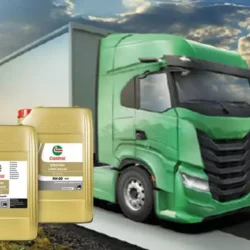
The Castrol VECTON Long Drain E8/E11 range
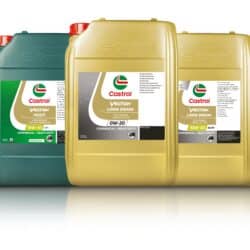
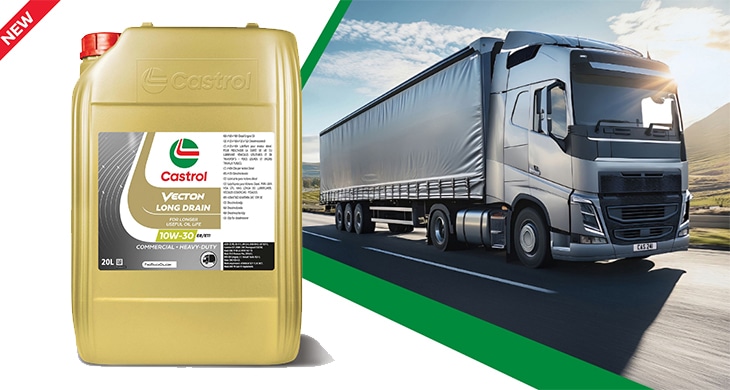
Castrol has introduced three key viscosity grades within its next-generation VECTON Long Drain E8/E11 offering.
Castrol VECTON Long Drain 5W-30 E8/E11
An advanced full-synthetic heavy-duty diesel engine oil designed for modern engines and extended-drain applications.
It carries ACEA E6, E8, E9 and E11 claims alongside a broad range of manufacturer specifications and approvals, making it particularly interesting when rationalising mixed fleets.
View Castrol VECTON Long Drain 5W-30 E8/E11 at Kernow Oils
Castrol VECTON Long Drain 10W-30 E8/E11
An advanced heavy-duty diesel engine oil engineered for longer useful oil life.
Its performance profile includes ACEA E6, E7, E8, E9 and E11, alongside API CK-4 and numerous manufacturer specifications and approvals.
View Castrol VECTON Long Drain 10W-30 E8/E11 at Kernow Oils
Castrol VECTON Long Drain 10W-40 E8/E11
For workshops where 10W-40 remains a major viscosity grade, VECTON Long Drain 10W-40 E8/E11 provides another potentially powerful rationalisation option.
It carries ACEA E6, E7, E8, E9 and E11, alongside API CK-4 and a wide selection of OEM performance claims and approvals.
View Castrol VECTON Long Drain 10W-40 E8/E11 at Kernow Oils
The wider Castrol commercial vehicle lubricant range from Kernow Oils provides options for applications that require other specifications.
Could three oils cover a large proportion of your workshop requirements?
Potentially – and that is the real opportunity.
Rather than viewing E8/E11 simply as another specification workshops have to stock, it makes sense to use the transition as an opportunity to review the entire lubricant inventory.
Ask:
Which vehicles do we maintain?
What specifications and OEM approvals do they actually require?
How many oils are we currently using?
Where are those requirements duplicated?
Could newer, broadly approved products safely consolidate several existing oils?
The result may be a substantially simpler lubricant inventory.
For a busy commercial vehicle workshop, simplification is not just about purchasing. It can help reduce the possibility of application errors and make lubricant management easier for technicians.
The important distinction: viscosity is not specification
One final point is worth reinforcing.
5W-30, 10W-30 and 10W-40 describe viscosity – not overall engine-oil performance.
The ACEA specification tells you considerably more about the performance standard the lubricant has been designed to meet, while OEM approvals determine suitability for particular manufacturer requirements.
So when an engine requires a particular specification, choosing another oil simply because the viscosity printed on the container is the same can be a costly mistake.
Always check:
- Viscosity
2. ACEA/API performance specification
3. OEM approval
4. Manufacturer recommendations
5. Permitted drain interval
Turn the E8/E11 change into an opportunity
The move from E6/E9 to E8/E11 reflects the continuing development of heavy-duty diesel engines.
For workshops, however, it also creates an opportunity.
Rather than simply adding another generation of oils to the lubricant store, review what is already being stocked and determine whether newer, broader-coverage lubricants can replace several existing products.
The result could be fewer oils, simpler stock management and a reduced risk of application errors – while still ensuring every engine receives the correct lubricant.
Kernow Oils can help commercial vehicle workshops review their current lubricant inventory, map OEM and ACEA requirements across the vehicles they maintain and identify opportunities for safe product rationalisation.
The aim isn’t one oil for everything. It is the fewest correct oils for everything you maintain.
Further technical information
Explore the Castrol VECTON commercial vehicle range
For further background on the ACEA categories, consult the latest ACEA Heavy-Duty Engine Oil Sequences and lubricant-industry technical resources.
 September 9, 2026