Keeping Passenger Fleets Moving: Why Premium Lubricants Pay for Themselves
For a bus or coach operator, reliability is everything.
A vehicle off the road is more than a workshop inconvenience. It can mean a missed service, replacement vehicle, recovery costs, overtime, disrupted passengers, reputational damage and lost revenue.
That makes lubricant selection much more important than simply comparing the price of a drum of oil.
For workshop and engineering managers looking to improve passenger fleet reliability, the question should not be:
“How cheaply can we buy our lubricants?”
It should be:
“Which lubricants will give us the lowest total cost of operation?”
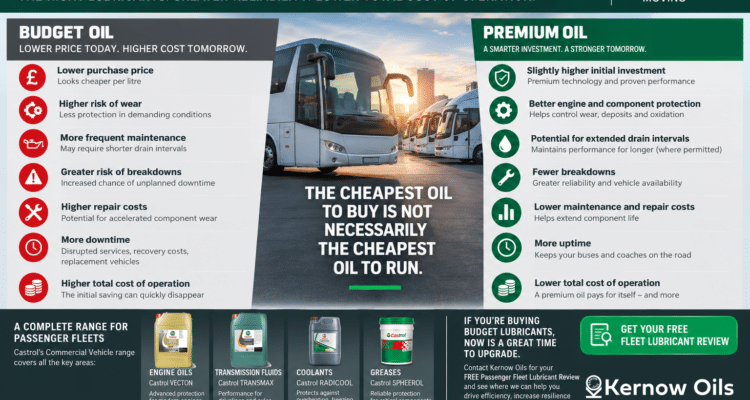
Premium, correctly specified lubricants may require a slightly higher initial investment, but better protection, longer lubricant life, improved component protection and reduced risk of unplanned maintenance can make that investment pay for itself many times over.
For passenger fleets where uptime is critical, lubricant performance should be considered an investment in reliability.
The True Cost of a “Cheap” Lubricant
Budget lubricants can look attractive when viewed purely as a price per litre.
But the oil itself represents only one part of the equation.
The real cost of operating a bus or coach includes servicing, labour, filters, replacement components, fuel, vehicle recovery, workshop time and – potentially most expensive of all – unplanned downtime.
Saving a relatively small amount on lubricant purchasing becomes a false economy if it contributes to accelerated wear, deposit formation, reduced component life or more frequent maintenance.
Premium lubricants are designed to perform under demanding conditions and maintain their protective properties for longer.
The potential benefits can include:
- Better engine and component protection
- Improved resistance to oxidation and deposits
- Longer lubricant and component life
- Potential for extended drain intervals where permitted by the vehicle manufacturer
- Reduced wear
- Improved transmission protection
- Protection against corrosion, overheating and cooling-system damage
- Fewer lubricant-related failures
- Reduced workshop intervention
- Greater vehicle availability
- Lower total cost of operation
The cheapest oil to buy is not necessarily the cheapest oil to run.
That distinction becomes particularly important in high-utilisation passenger fleets.

Four Areas Every Bus & Coach Workshop Should Review
A passenger vehicle does not depend on engine oil alone. Its reliability is supported by a complete lubrication and fluid system.
When reviewing a fleet, Kernow Oils recommends considering four core areas.
-
Engine Oil – Protecting the Heart of the Vehicle
Modern heavy-duty diesel engines place significant demands on their engine oil.
Higher temperatures, pressures, emissions-control systems, extended servicing requirements and increasingly sophisticated engine technology mean that simply selecting an oil by viscosity is no longer sufficient.
The lubricant needs to meet the correct OEM and industry specification for the individual engine.
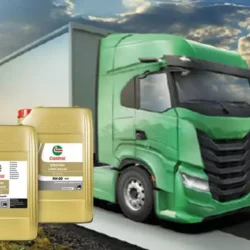
Castrol VECTON is Castrol’s advanced heavy-duty diesel engine oil range, designed to support commercial vehicle performance and reliability.
The latest VECTON portfolio includes products designed around modern ACEA E8/E11 requirements as well as oils for different OEM and fleet requirements.
For example, Castrol VECTON Long Drain 5W-30 E8/E11 is an advanced full synthetic heavy-duty diesel engine oil suitable for highly rated diesel engines from Euro I through to Euro VI, including many engines using DPF, EGR and SCR technologies.
Its System Pro Technology™ is designed to fight oil breakdown by controlling oxidation and deposits, neutralising harmful acids, controlling aeration and maintaining viscosity under demanding operating conditions.
Selected VECTON Long Drain products are approved for extended drain intervals of up to 120,000 km in specified applications. Actual drain intervals must always follow the vehicle manufacturer’s requirements and take account of operating conditions, service history and oil monitoring.
Explore: Castrol VECTON Long Drain 5W-30 E8/E11
Explore the Castrol Commercial Vehicle range
The objective isn’t simply longer oil life. It is maintaining protection and reliability throughout the service interval.
-
Transmission & Driveline Fluids – An Area You Cannot Afford to Ignore
Engines tend to receive most of the attention, but transmission and driveline failures can be extremely expensive.
Bus and coach transmissions operate for long periods, frequently under demanding duty cycles involving repeated acceleration, braking, gear changes and variable operating temperatures.
The correct transmission lubricant helps protect gears and bearings against wear while maintaining the required frictional characteristics and performance.
Castrol TRANSMAX provides a comprehensive range of transmission, axle and driveline fluids, including products developed specifically for commercial vehicle applications.
Some products can also help fleets rationalise their lubricant inventory. Castrol Transmax Universal LL 75W-90, for example, is a full synthetic lubricant designed for use across suitable manual transmission and final-drive applications and carries multiple OEM approvals.
This can potentially reduce the number of products held in the workshop while reducing the risk of lubricant misapplication.
Explore Castrol Transmax Universal LL 75W-90
Using the correct premium transmission lubricant can help protect components under high loads and temperatures, potentially extending component and lubricant life.
Given the cost of transmission repair or replacement – and the downtime that accompanies it – driveline lubricant is a poor place to make savings based solely on purchase price.
-
Coolant – Much More Than Freeze Protection
Coolant is sometimes treated as a seasonal product. In reality, it performs a vital protective role throughout the year.
Modern commercial vehicle cooling systems operate under significant thermal loads. The correct coolant helps control temperature while protecting against freezing, corrosion and cavitation.
Using an unsuitable coolant, incorrect concentration or mixing incompatible coolant technologies can compromise that protection.
The Castrol RADICOOL range provides coolants and antifreezes for a wide variety of applications.
For example, Castrol Radicool NF provides corrosion and low-temperature protection while also helping protect wet cylinder liners against cavitation erosion.
For workshop managers, coolant should therefore be managed as an important engineering fluid – not simply topped up when the level drops.
Check the correct specification, concentration, condition and replacement interval for each vehicle.
-
Grease – Small Quantity, Important Job
Grease may represent a tiny proportion of a fleet’s lubricant spend, but it protects components that can be expensive and inconvenient to replace.
Bearings, pivots, joints and other heavily loaded components rely on the correct grease to maintain a protective lubricating film.
Castrol’s commercial vehicle grease portfolio includes multi-purpose and specialist products designed for different operating loads, temperatures and applications.
The Castrol SPHEEROL range includes products formulated to resist pressure, temperature and wear, helping protect components and support maintenance intervals.
Explore commercial vehicle greases
Again, specification matters. The cheapest general-purpose grease is not automatically the correct grease for every lubrication point.
Premium Lubricants: Look Beyond the Price Per Litre
Consider two oils.
Budget Oil A costs less per litre.
Premium Oil B costs slightly more.
If Oil B provides stronger protection, remains effective for longer, helps keep components cleaner, supports longer service intervals where permitted and contributes to improved component reliability, which is really the cheaper product?
The answer only becomes clear when you measure Total Cost of Operation rather than Cost Per Litre.
For a passenger fleet, the calculation should consider:
Lubricant cost + servicing + labour + filters + parts + repairs + recovery + downtime + vehicle availability
A small saving on lubricant price can disappear instantly when a vehicle requires an additional workshop visit – never mind a premature component failure or roadside breakdown.
This is why premium lubrication should not simply be viewed as an additional cost.
It is preventative investment.
The Cost of Downtime Changes the Equation
Passenger fleets have another consideration: the vehicle has a job to do at a specific time.
A bus needs to operate its route. A coach needs to collect its passengers.
When that vehicle is unavailable, the operator cannot simply wait until it is convenient to repair it.
A replacement may have to be found. Workshop schedules are disrupted. Drivers and passengers can be affected. In the worst cases, the operator’s reputation suffers.
This makes reliability particularly valuable.
If spending a little more on correctly specified, high-performance lubricants helps reduce the probability of failures and increases equipment availability, the return can be significantly greater than the difference in lubricant purchase price.
Why Castrol for Bus & Coach Fleets?
Castrol is one of the world’s established lubricant technology brands and its commercial vehicle portfolio provides a joined-up approach to fleet lubrication.
The range includes:
Castrol VECTON – heavy-duty diesel engine oils
Castrol TRANSMAX – transmission, axle and driveline lubricants
Castrol RADICOOL – engine coolants and antifreeze
Castrol SPHEEROL and specialist greases – component lubrication
Castrol HYSPIN – hydraulic oils for relevant fleet and workshop applications
Rather than treating each product simply as a consumable, Kernow Oils can help passenger fleet operators select lubricants around the vehicle, its OEM requirements, operating environment and service regime.
Could Your Fleet Use Fewer Lubricants?
There is another potential saving available to mixed passenger fleets: lubricant rationalisation.
A workshop may accumulate different engine oils, transmission fluids, coolants and greases as vehicles are added or replaced.
Over time, this can create an unnecessarily complicated lubricant inventory.
A technical review may identify opportunities to consolidate compatible requirements onto fewer high-performance products – without compromising the OEM specifications required by individual vehicles.
Done correctly, rationalisation can mean:
- Fewer products to purchase and stock
- Reduced inventory
- Simpler workshop management
- Less chance of selecting the wrong lubricant
- Easier technician training
- Reduced waste
- Greater purchasing efficiency
The important point is that rationalisation must be specification-led, not based simply on viscosity or product description.
If You’re Buying Budget Lubricants, Now Is a Good Time to Review
If lubricant purchasing has historically been driven primarily by price, now is an excellent opportunity to reconsider the strategy.
Ask what the lubricant is actually costing your operation.
Are you purchasing the correct specifications?
Could higher-performance products improve protection?
Could your engine oils be rationalised?
Are the correct transmission fluids being used?
Are coolant specifications and concentrations being properly managed?
Are grease applications matched to the correct products?
Could premium products help reduce maintenance requirements and improve vehicle availability?
Most importantly:
Could spending slightly more on lubrication help you spend considerably less on running the fleet?
For many operators, that is where the real opportunity lies.
Get a FREE Passenger Fleet Lubricant Review
Kernow Oils can review your current lubricant requirements and help identify opportunities to improve reliability, simplify product inventories and reduce total operating costs.
As Castrol’s Official Commercial Vehicle Partner Distributor, Kernow Oils combines access to Castrol’s commercial vehicle lubricant technology with specialist technical support and practical fleet experience.
Our approach is simple:
ADVICE – SUPPLY – SUPPORT
We can review your engines, transmissions, coolants, greases and other lubrication requirements against your current products and help identify opportunities for improved performance and rationalisation.
Keep your passengers moving – and your costs under control.
Contact Kernow Oils for your FREE Passenger Fleet Lubricant Review and discover where better lubrication could help your operation drive efficiency, increase resilience and save money.
https://www.kernow-oils.co.uk/
Useful external resources
Castrol VECTON – Heavy-Duty Diesel Engine Oils
https://www.castrol.com/en_gb/united-kingdom/home/products/our-brands/commercial/castrol-vecton.html
Castrol Commercial Vehicle Transmission Fluids
https://www.castrol.com/en_gb/united-kingdom/home/products/commercial-vehicle/commercial-vehicle-transmission-fluids.html
Castrol Commercial Vehicle Coolants
https://www.castrol.com/en_gb/united-kingdom/home/products/commercial-vehicle/commercial-vehicle-coolants-antifreeze.html
Castrol Commercial Vehicle Greases
https://www.castrol.com/en_gb/united-kingdom/home/products/commercial-vehicle/commercial-vehicle-greases.html
 September 25, 2026