Volvo VDS-5 Engine Oil: Everything Commercial Vehicle Workshops Need to Know
For commercial vehicle workshops, choosing engine oil used to appear relatively straightforward: identify the viscosity, check the required specification and fill the engine.
Modern heavy-duty engines have made that decision considerably more important. As manufacturers pursue lower emissions, improved fuel economy, longer service intervals and greater engine efficiency, lubricant specifications are becoming increasingly specialised. Volvo VDS-5 is an excellent example.
Designed for a newer generation of fuel-efficient Volvo engines, VDS-5 represents an important change from previous Volvo oil specifications. Crucially, VDS-5 is not backwards compatible with VDS-4.5 applications. That makes understanding the specification essential for workshop managers servicing mixed-age commercial vehicle fleets.
What is Volvo VDS-5?
VDS stands for Volvo Drain Specification. Volvo develops its own engine oil requirements covering factors including viscosity, industry performance sequences and additional physical, chemical and engine testing.
VDS-5 was developed for newer, fuel-efficient heavy-duty Volvo engine technology and represents a move towards lower-viscosity lubricants designed to reduce internal engine losses while continuing to provide the required levels of protection. It is therefore much more than another number on an oil container. For workshops, VDS-5 demonstrates an increasingly important principle:
The viscosity grade alone no longer tells you whether an engine oil is suitable for a vehicle.
Two products can both be labelled 5W-30 while having very different performance characteristics, approvals and intended applications.
Why is VDS-5 so fuel efficient?
A major objective behind VDS-5 is improved fuel economy.
One of the ways an engine oil influences efficiency is through the energy required to circulate the lubricant and overcome friction within the engine.
VDS-5 uses a lower-viscosity approach than previous generations. In simple terms, reducing the resistance created by the lubricant can reduce parasitic losses within an engine specifically engineered to operate with that oil.
The specification is closely associated with API FA-4, the heavy-duty diesel oil category developed for selected newer engines.
API FA-4 oils have a High Temperature High Shear (HTHS) viscosity range of approximately 2.9–3.2 cP. This reduced HTHS viscosity is specifically intended to contribute towards reduced greenhouse-gas emissions and improved efficiency while maintaining the protection required by compatible engines.
This is where the engineering becomes important.
The objective isn’t simply to make the oil “thinner”.
The engine and lubricant have effectively been engineered to work together.
The lubricant still needs to provide protection against areas such as:
- oxidation;
- viscosity loss through shear;
- oil aeration;
- engine wear;
- piston deposits;
- soot-related viscosity increase;
- catalyst poisoning; and
- particulate filter blockage.
Achieving lower lubricant-related energy losses while maintaining this protection is what makes modern specifications such as VDS-5 technologically significant.
So why isn’t VDS-5 backwards compatible?
This is perhaps the most important point for commercial vehicle workshops.
A newer specification does not automatically mean it can replace every specification that came before it.
VDS-5 is specifically not backwards compatible for older Volvo engines. Why? Because those engines were not designed around the same lower-viscosity lubricant characteristics. Volvo explains that using VDS-5 in older engines can result in lower oil pressure, potentially causing oil pressure to become too low under certain operating conditions and triggering dashboard warnings. This creates a counter-intuitive situation.
A technologically newer lubricant can be exactly right for a new engine and completely inappropriate for an older one. For workshops maintaining fleets containing different generations of Volvo vehicles, this makes lubricant identification, storage and dispensing increasingly important.
VDS-4.5 vs VDS-5 – what changed?
The progression from VDS-4.5 to VDS-5 is not simply about demanding “better oil”. The requirements reflect changes to the engines themselves. Broadly, the change can be viewed across several areas:
Fuel economy: VDS-5 places substantially greater emphasis on reducing lubricant-related frictional losses.
HTHS viscosity: VDS-5/FA-4 technology uses a lower HTHS viscosity than conventional heavy-duty oil categories.
Engine compatibility: VDS-4.5 has considerably broader legacy compatibility, whereas VDS-5 is application-specific.
Oil pressure requirements: The lower viscosity characteristics that help provide VDS-5’s efficiency advantages are precisely why the oil should not simply be introduced into older engines.
Oxidation protection: Modern engines operate under increasingly demanding temperatures and pressures, requiring excellent resistance to oil degradation.
Emissions and after-treatment compatibility: Modern specifications must work alongside increasingly sophisticated emissions-control systems.
The important workshop message is therefore simple:
Newer doesn’t mean backwards compatible. The specification matters as much as the viscosity
Consider two containers carrying the same familiar number:
5W-30
It would be easy to assume they are interchangeable.
They aren’t necessarily.
One 5W-30 could be designed around VDS-4.5/API CK-4-type requirements while another is an API FA-4/VDS-5 lubricant engineered for compatible fuel-efficient engines.
Their SAE viscosity grade may look identical on the container, but their HTHS viscosity, OEM approvals, engine compatibility and intended application can be significantly different.
That is why workshops should increasingly select engine oils by:
Vehicle → Engine → OEM specification → Approval → Viscosity
rather than:
Viscosity → Oil

Why manufacturers develop their own oil specifications
Modern commercial vehicle engines are increasingly sophisticated systems. Turbocharging, high injection pressures, emissions after-treatment, higher operating temperatures, reduced internal friction and longer service intervals place substantial demands on the lubricant. Manufacturers therefore establish lubricant specifications around the engineering requirements of particular engines.
The correct oil contributes to areas including:
- wear protection;
- engine cleanliness;
- oil pressure;
- turbocharger protection;
- oxidation control;
- emissions-system compatibility;
- fuel economy;
- drain interval capability; and
- overall engine durability.
Using the specified lubricant is therefore part of maintaining the engine as its manufacturer intended.
Could using the wrong engine oil affect warranty?
Potentially, yes.
A vehicle warranty is subject to the manufacturer’s terms and conditions, so workshops should always refer to the relevant service information rather than assuming a particular outcome. However, if an engine requires an approved oil specification, using a lubricant that does not satisfy that requirement could create problems if a lubrication-related failure subsequently occurs. From a workshop perspective, the safest approach is simple:
Follow the vehicle manufacturer’s current lubricant recommendation and keep accurate service records showing exactly which product was used.
Oil specifications should be treated as engineering requirements rather than purchasing suggestions.
The mixed-fleet workshop problem
The arrival of specifications such as VDS-5 creates another challenge. Many workshops now service vehicles spanning several generations. One workshop could therefore encounter vehicles requiring VDS-3, VDS-4, VDS-4.5 and VDS-5 oils alongside completely different specifications from Mercedes-Benz, MAN, Scania, DAF, Renault Trucks and other manufacturers.
Traditionally, lubricant rationalisation has helped workshops reduce stockholding and simplify dispensing. That remains valuable – but rationalisation must never override compatibility. With VDS-5, in particular, workshops need to prevent a newer low-viscosity lubricant being treated as a universal replacement for older Volvo specifications. Clear tank identification, dispensing labels, technician training and accurate lubricant application data become increasingly important.
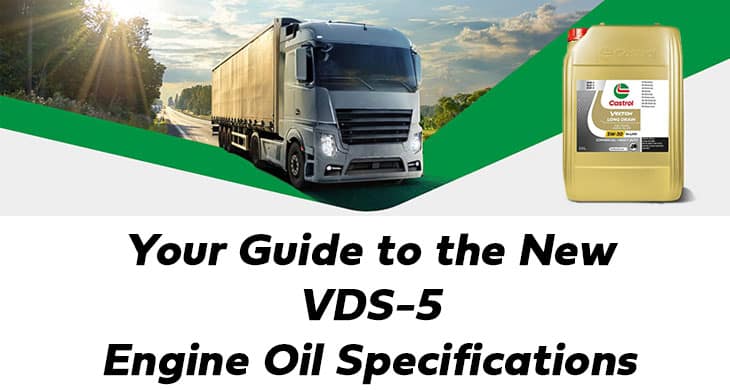
Castrol VECTON Long Drain 5W-30 FA-4/F01
For workshops requiring a lubricant approved against the new specification, Castrol VECTON Long Drain 5W-30 FA-4/F01 is an advanced full-synthetic heavy-duty diesel engine oil within the Castrol VECTON Long Drain range.
Its specifications and approvals include:
Volvo VDS-5
Mack EOS-5
Renault Trucks RLD-5
ACEA F01
API FA-4
Cummins CES 20087
DDC DFS 93K223
DTFR 15C130
Castrol VECTON Long Drain 5W-30 FA-4/F01 uses System Pro Technology™, designed to fight oil breakdown by helping control oxidation and deposits, neutralise harmful acids and maintain viscosity under demanding operating conditions.
That combination makes it particularly relevant to workshops servicing the latest generation of highly rated, fuel-efficient commercial diesel engines.

VDS-5: the workshop checklist
Before carrying out an oil change or top-up:
- Identify the exact vehicle and engine.
Don’t rely purely on make, model or registration year. - Check the manufacturer’s current lubricant requirement.
Confirm the required OEM specification. - Check the oil approval – not simply its viscosity.
“5W-30” alone is not sufficient information. - Don’t assume newer specifications are backwards compatible.
VDS-5 is an important example of why this assumption can be dangerous. - Keep VDS-5 clearly identified in the workshop.
Avoid accidental dispensing into legacy engines. - Record the oil used during servicing.
Good lubricant records provide useful maintenance and warranty documentation. - Ask for technical advice when uncertain.
A few minutes spent checking an application is considerably cheaper than dealing with an incorrectly lubricated engine.
The bigger lesson from VDS-5
VDS-5 illustrates how dramatically commercial vehicle lubrication is changing. Lubricants are increasingly becoming part of the engine’s engineering strategy for reducing fuel consumption, controlling emissions and maximising durability. That means the old approach of selecting an oil because it has “the right viscosity” is becoming increasingly risky.
A 5W-30 is not simply a 5W-30.
The specifications and OEM approvals printed alongside that viscosity are what tell the workshop where the lubricant belongs. For the latest compatible Volvo engines requiring VDS-5, Castrol VECTON Long Drain 5W-30 FA-4/F01 provides a fully synthetic solution carrying the required Volvo VDS-5 approval alongside API FA-4 and other leading heavy-duty OEM specifications. For older vehicles, however, the correct VDS-4.5 or other manufacturer-approved lubricant should continue to be selected where specified.
Correct engine. Correct specification. Correct oil.
For a commercial vehicle workshop, those three checks can help protect engine reliability, fuel economy, customer vehicles – and the workshop itself.
 September 9, 2026